Photographer Dorothea Lange’s image titled Part of a line waiting for lunch outside the mess hall at noon exemplifies Lange’s respect towards her subjects and more specifically Lange’s resistance to using the camera to “express her inner consciousness”(Gordon), tho still raising ethical and moral tensions from what brings Lange to the work. A major aspect of Lange’s respect for her subjects came from her focus on visual pleasure, aesthetics, and beauty. While what Lange saw in her subjects inherently did come from her own consciousness (emotions/perceptions), she tried to take photos of people in a way that is representative of a general problem, while particular to a specific person or group. I believe that Lange does a good job at achieving this in the photograph since it shows (from a distance) a specific group of people waiting on line to have lunch without feeling like they are interupting the scene they are filming. While some can interpret the image as respecting the lives of Japanese Americans in internment camps, displaying empathy, and sharing historical counternarratives, others might think that Lange is exploiting and/or misinterpreting the lives of Japanese Americans. Others, like Gordon, argue that documentary photographs should make people question reality and should not give them an answer. Leaving photos up to interpretation allows the public to critically see, think, and be involved in a form of democratic participation. Is this enough? If Lange’s photographs are good enough for the sake of American democracy, are their ethical implications justified? Can Lange’s subjects be respected on-camera but not off-camera? Regardless, I believe that it is essential to locate Lange within the photo in order to have the context to interpret not only Lange’s framing but also the greater truth and social justice messaging Lange wants the public to take away from her work.
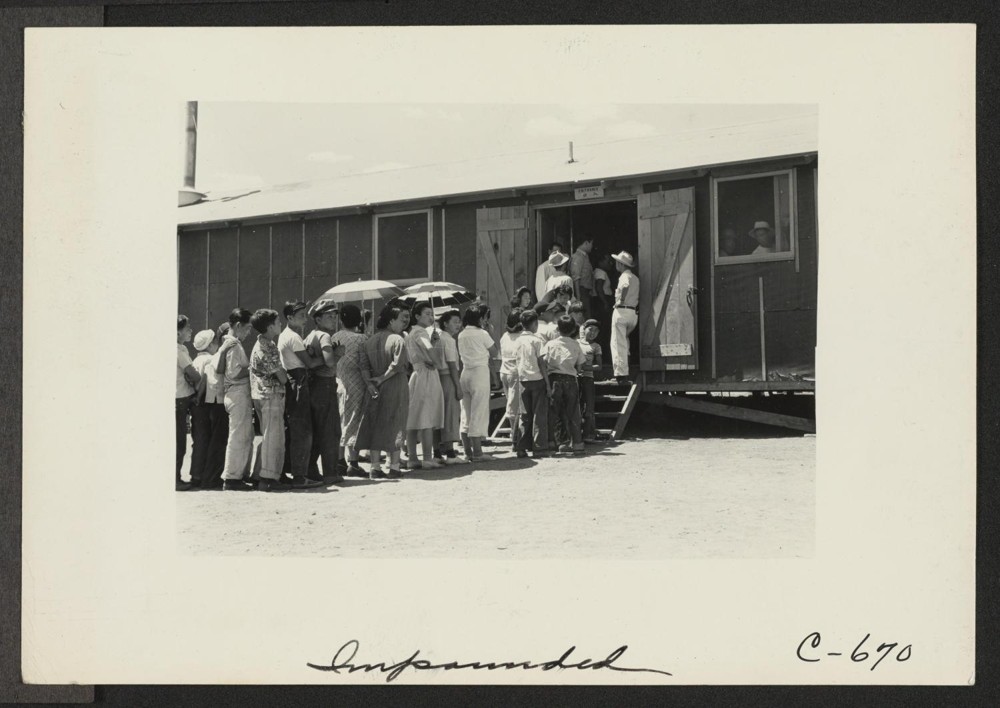
Lange, Dorothea. Part of a line waiting for lunch outside the mess hall at noon. War Relocation Authority Photographs of Japanese-American Evacuation and Resettlement, 1942-1945 circa 1941-1947. University of California, Berkely Library Digital Collections. https://digicoll.lib.berkeley.edu/record/106503?v=uv#?xywh=-255%2C-389%2C1666%2C1205
Gordon, Linda. Dorothea Lange: A Life Beyond Limits. New York, NY, W.W. Norton & Company.